

Is Myhna Vistara Vastu Compliant? A Room-by-Room Look
Is Myhna Vistara Vastu Compliant? A Room-by-Room Look Contents Almost every second phone call our sales team gets from
If you have visited more than two or three apartment sites in Bangalore recently, you have probably heard a sales executive mention “MIVAN technology” at some point usually said with a confident nod, as if it should mean something to you.
Most buyers nod back and move on. I did too, the first time I heard it.
But this is actually one of the more important things to understand before buying an under-construction apartment, because it directly affects three things you genuinely care about how sturdy your home will be, how long the project will take to build, and, somewhat surprisingly, what your apartment will be worth when you eventually sell it.
Here is what MIVAN construction actually is, why developers are switching to it, and what questions you should be asking when a sales team mentions it.
MIVAN is a construction method that uses aluminium formwork instead of traditional wooden or steel shuttering to cast concrete walls, slabs, beams and columns essentially the entire structural skeleton of a building in a single continuous pour.
Think of it this way: in conventional construction, workers build a wooden frame (formwork) for each wall and slab, pour concrete into it, wait for it to cure, remove the wood, and move to the next section. It is a sequential, labour-intensive process.
With MIVAN, precision-engineered aluminium panels are assembled into a mould for an entire floor walls, slabs, and all and concrete is poured in one go. Once cured, the aluminium panels are removed and moved up to the next floor. It is closer to a repeatable, factory-style process than traditional site-by-site construction.
The technology originated in Europe, was adapted for high-volume residential construction in Malaysia (the name “MIVAN” comes from an Irish/UK formwork company that pioneered the system), and has been used in India for roughly the last 12-15 years, primarily by larger developers building high-rise towers.
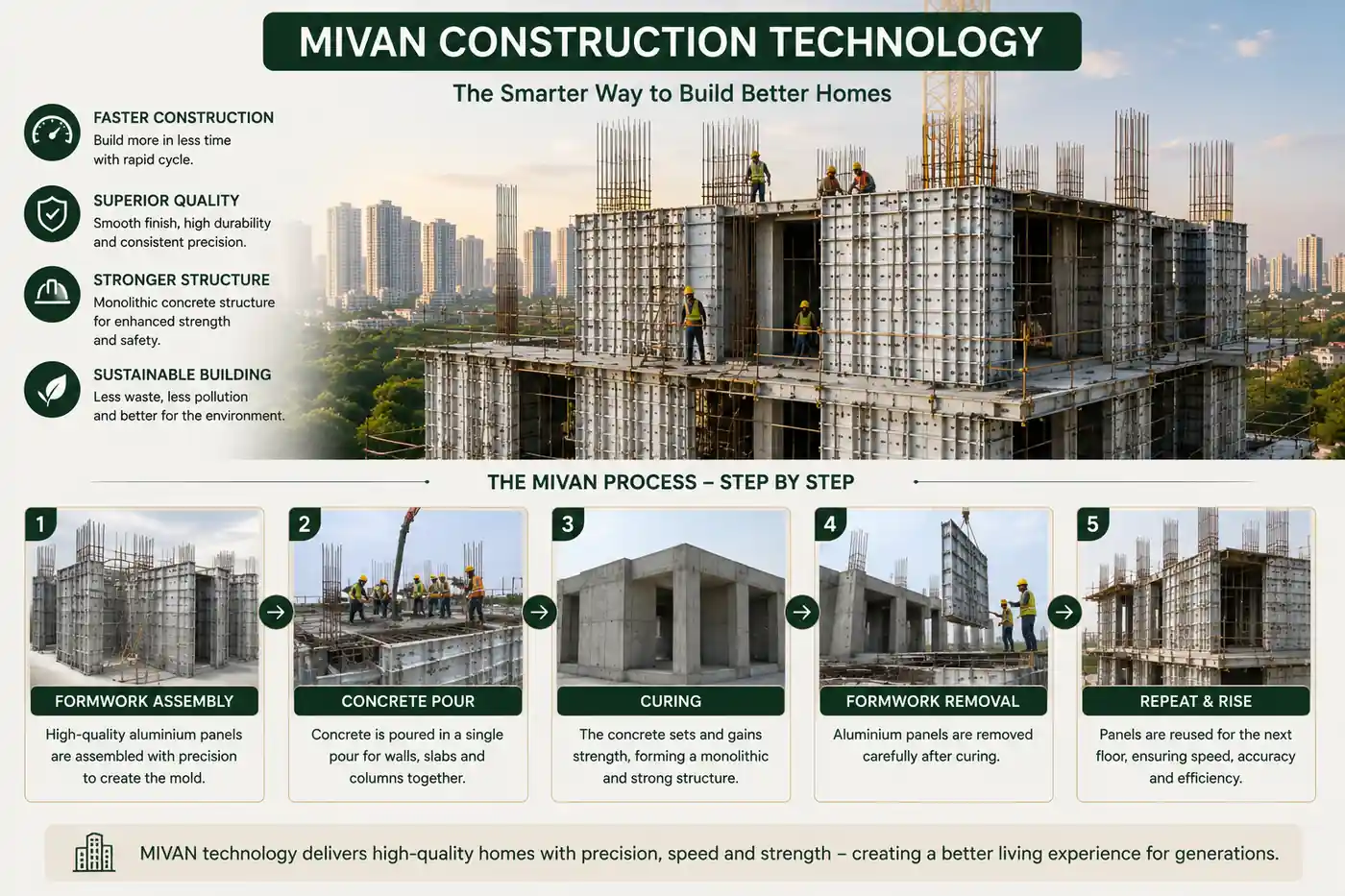
I spoke with a structural engineer friend about this while researching for this piece, and he broke it down into three practical reasons developers give for adopting MIVAN over conventional construction:
Speed. Because an entire floor’s walls and slab are cast in a single pour, and the aluminium formwork can be reused within a much shorter cycle than wooden shuttering, MIVAN construction can complete a floor every 5-7 days once the process is running smoothly, compared to 10-15 days for conventional methods on a comparable structure.
Structural consistency. Because walls and slabs are monolithic poured together as one continuous piece rather than joined afterward there are fewer construction joints, which are historically one of the more common sources of cracks and water seepage in Indian apartments over time.
Reduced dependency on skilled labour for finishing. MIVAN walls come out of the formwork with a smoother finish than conventional shuttering, reducing the plastering work required which also reduces the number of finishing trades needed on site and the associated quality variability that comes with manual plastering across a large project.
I want to be fair here rather than present MIVAN as a flawless solution, because it genuinely isn’t one for every situation.
Higher upfront capital cost for the developer. Aluminium formwork systems are expensive to procure and are typically only cost-effective at scale meaning MIVAN makes the most sense for large projects with many repetitive floor plans, which is exactly why you mostly see it used in high-rise townships rather than smaller boutique developments.
Less design flexibility once construction begins. Because the formwork is precision-engineered for a specific floor plan, making late-stage design changes to a MIVAN project is significantly more disruptive and expensive than in conventional construction, where formwork can be adjusted more easily on site.
It requires disciplined project management. The speed advantage of MIVAN only materialises if the construction schedule, material supply, and labour coordination are managed tightly. A poorly managed MIVAN project does not automatically move faster than a well-managed conventional one — the technology is an enabler, not a guarantee.
Here is where I think most marketing material stops short of giving buyers something actually useful.
Ask about the construction cycle time being achieved on site, not just the technology name. A developer using MIVAN but achieving only 12-14 days per floor is not getting a meaningful speed advantage over conventional construction — the technology’s benefit is only realised with disciplined execution. If you are seriously evaluating a project, ask directly: “What is your current floor-to-floor construction cycle?”
Ask to see the raw wall finish, if a sample or completed unit is available. A genuine MIVAN wall should show minimal joint lines and a relatively smooth cast finish straight out of formwork, before any plastering. This is one of the easiest ways to verify the claim on a site visit rather than relying on the brochure.
Understand that MIVAN reduces certain risks but does not eliminate the need for quality waterproofing and finishing work. The monolithic structure reduces structural joint-related seepage risk, but bathroom waterproofing, external facade sealing, and plumbing installation quality still depend entirely on the contractor’s execution MIVAN does not automatically solve these separately.
This is the part that surprised me most while researching.
Resale buyers in Bangalore, particularly those who have been through the experience of dealing with cracks, seepage, or uneven walls in an older apartment, are increasingly asking about construction method during resale negotiations not as a decisive factor on its own, but as one signal among several that a project was built with a certain standard of process discipline.
A monolithic MIVAN structure, properly executed, tends to show fewer of the hairline cracks along wall-slab junctions that are a common complaint in older conventional constructions, particularly as a building settles over its first 5-10 years. This does not mean every MIVAN building is problem-free waterproofing failures and plumbing issues can happen regardless of structural method but the specific category of joint-related structural cracking is genuinely reduced by the monolithic pour.
Myhna Vistara in Gunjur is one of the projects in East Bangalore built using MIVAN aluminium formwork technology across its G+31 towers. For a high-rise of this scale 6 towers rising 31 floors each the case for MIVAN is exactly the scenario where the technology is best suited: large repetitive floor plates across multiple identical towers, which is precisely the kind of project where the upfront cost of aluminium formwork pays off in construction speed and consistency.
If you are evaluating this or any MIVAN project, it is worth asking the sales team directly what floor-to-floor cycle time they are currently achieving, and whether a sample flat or a completed lower floor is available for you to inspect the wall finish firsthand, rather than relying solely on the technology name in the brochure.
If you are evaluating this or any MIVAN project, it is worth asking the sales team directly what floor-to-floor cycle time they are currently achieving, and whether a sample flat or a completed lower floor is available for you to inspect the wall finish firsthand, rather than relying solely on the technology name in the brochure.
| Factor | MIVAN Construction | Conventional Construction |
|---|---|---|
| Typical floor cycle time | 5–7 days (well-managed site) | 10–15 days |
| Wall-slab joints | Minimal — monolithic pour | More frequent — sequential casting |
| Design flexibility mid-construction | Lower | Higher |
| Best suited for | Large-scale, repetitive floor plans | Smaller or highly customised projects |
| Upfront developer cost | Higher (formwork investment) | Lower |
| Structural crack risk (joint-related) | Generally lower | Generally higher over time |
| Finishing/plastering requirement | Lower | Higher |
Honestly it should be one input among several, not the deciding factor on its own.
A well-executed conventional construction project by an experienced, disciplined developer can still deliver excellent quality. Conversely, a poorly managed MIVAN project does not automatically outperform it just because of the technology name on a brochure.
What MIVAN does tell you, when combined with other signals a developer’s track record, RERA compliance history, and the visible quality of ongoing construction — is that a developer has made a capital commitment to a modern construction process, typically reserved for larger, more serious project scales. It is a useful data point in your overall evaluation, not a substitute for doing that evaluation.
For projects like Myhna Vistara, where MIVAN is being used across a genuinely large-scale, RERA-approved township, it is a reasonable signal of construction approach — but I would still recommend any serious buyer visit the site, ask about current cycle times, and inspect visible construction quality directly rather than relying on the technology name alone.
If you want to understand what MIVAN construction actually looks like at this stage of a project’s development, Myhna Vistara’s construction updates are published regularly and reflect the current foundation and substructure phase, with above-ground MIVAN casting to follow as the project progresses through 2026-2027.
MIVAN is a construction method that uses aluminium formwork to cast an entire floor's walls, slabs, beams and columns in a single continuous concrete pour, rather than the sequential wooden-shuttering process used in conventional construction. It originated in Europe and has been used in large-scale Indian residential projects for over a decade.
MIVAN offers faster construction cycles and fewer structural joints, which can reduce certain types of long-term cracking. However, it requires disciplined project management to realise its speed advantage and is best suited to large, repetitive-floor-plan projects. A well-managed conventional construction project can still deliver excellent quality — the construction method is one input among several when evaluating a project, not a standalone guarantee of quality.
MIVAN's monolithic pour reduces the number of wall-slab construction joints, which are a common source of hairline cracking in conventional buildings as they settle over time. It does not eliminate all crack or seepage risks — bathroom waterproofing, facade sealing, and plumbing installation quality remain dependent on contractor execution regardless of structural method.
A well-managed MIVAN construction site can achieve a floor cycle time of approximately 5-7 days, compared to 10-15 days for conventional construction on a comparable structure. This speed advantage depends heavily on disciplined site management and material supply coordination — the technology enables faster construction but does not guarantee it automatically.
MIVAN is primarily used by larger developers building high-rise towers with repetitive floor plans, since the upfront cost of aluminium formwork is best justified at scale. Myhna Vistara in Gunjur, a G+31 township with 6 towers, is one such project using MIVAN construction technology across its structure.
Ask specifically what floor-to-floor construction cycle time they are currently achieving on site, rather than relying on the technology name alone. If possible, request to inspect a completed lower floor or sample flat to see the raw wall finish before plastering, which is one of the most direct ways to verify construction quality on a site visit.
MIVAN requires a higher upfront capital investment from the developer for the aluminium formwork system, but this is typically absorbed into the overall project economics at scale rather than passed on as a distinct line-item cost to individual buyers. Pricing differences between MIVAN and conventional projects are usually driven more by location, developer positioning, and amenities than by construction method alone.
Increasingly, resale buyers in Bangalore are asking about construction method as one factor among several when evaluating an apartment, particularly given common complaints about cracking and seepage in older conventional constructions. A monolithic MIVAN structure, properly executed, is generally viewed as a positive signal, though it is not the sole determinant of resale value, which also depends on location, maintenance, and overall building condition over time.
Is Myhna Vistara Vastu Compliant? A Room-by-Room Look Contents Almost every second phone call our sales team gets from

A First-Time Homebuyer’s Guide to Gunjur — Documents, Loan Process, and What to Actually Check Contents The first time I
Buying Property in Gunjur From Abroad — An NRI’s Guide to Myhna Vistara Contents Every few weeks, I get some

Gunjur Property Price Trends 2026-2030 — What the Data Actually Shows Contents Every investor asking about Gunjur eventually asks some
3 BHK vs 4 BHK in Gunjur — Which Is the Smarter Buy in 2026? Contents Every family we’ve spoken
Top Schools Near Gunjur CDP Road — A Parent’s Complete Guide Contents When we started seriously considering a move
Exclusive Offers | Download Brochure | Schedule Site Visit