

A First-Time Homebuyer’s Guide to Gunjur
A First-Time Homebuyer’s Guide to Gunjur — Documents, Loan Process, and What to Actually Check Contents The first time I
The first time I sat across a sales desk being handed a stack of documents to sign, I genuinely didn’t know what half of them meant. Allotment letter. Sale agreement. Encumbrance certificate. Everyone around me seemed to nod along like this was normal, and I remember feeling a bit embarrassed to ask what an “OC” was.
If you’re a first-time home buyer in Gunjur, Bangalore, a corridor where new projects are launching every few months, that feeling is completely normal. Nobody teaches this in school, and most of us learn it the hard way, one confusing document at a time.
This is the guide I wish someone had handed me before my first purchase. It’s not about which project to pick. It’s about the actual mechanics of buying the documents, the loan process, and the specific things worth double-checking before you commit real money to something you’ll likely be paying off for the next two decades.
This sounds obvious, but it’s the step most first-time buyers skip or do backwards; they fall in love with a floor plan first, then try to make the numbers work.
A more honest approach: figure out your actual affordability before you start seriously shortlisting. A commonly used rule of thumb is that your total EMI (across all loans, not just the home loan) shouldn’t exceed 40-50% of your monthly take-home income. Banks will often approve you for more than this comfortable threshold just because a bank says you qualify for a ₹2 Cr loan. It doesn’t mean taking one is a good idea for your actual lifestyle and other financial goals.
Also budget separately for costs beyond the property price itself: stamp duty and registration (typically 5-7% of property value in Karnataka), GST on under-construction property, brokerage if applicable, and a buffer for interior work and moving costs. First-time buyers frequently underestimate this second bucket by a significant margin.
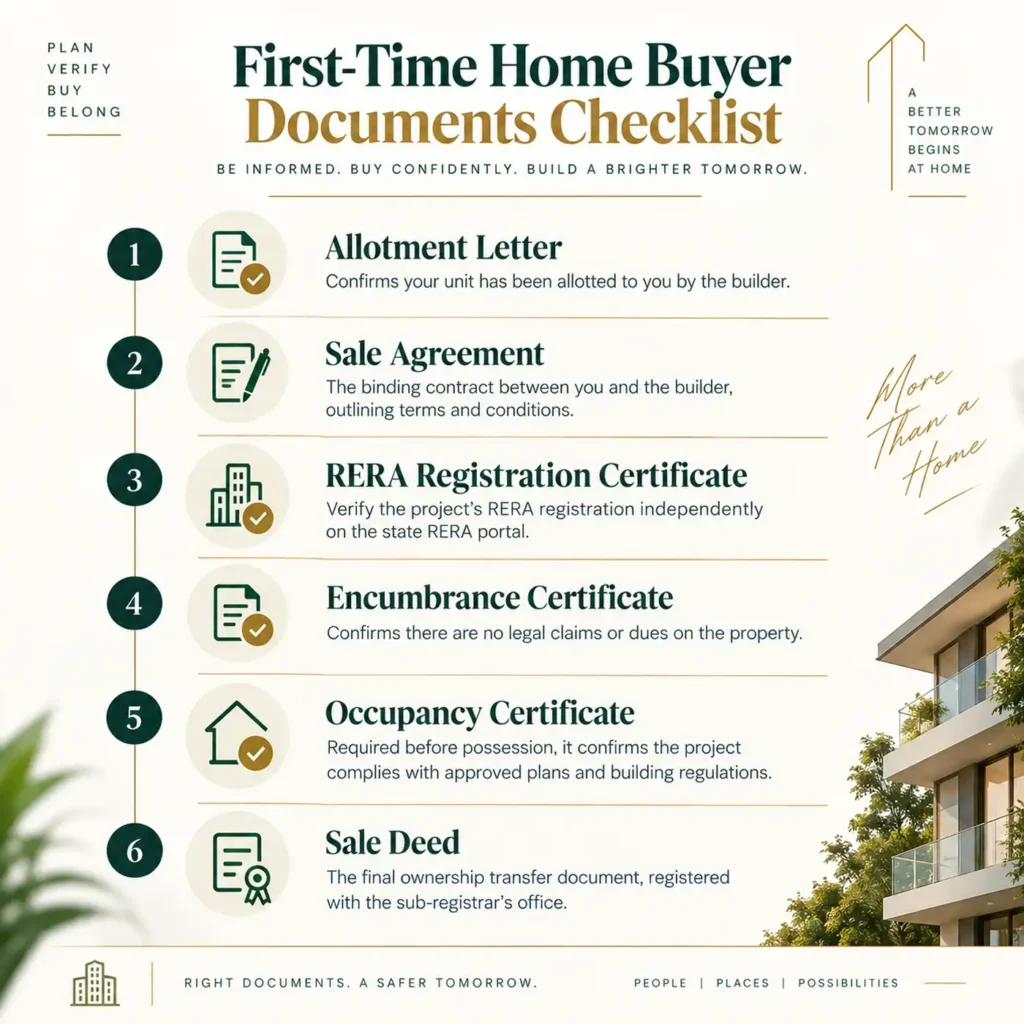
Here’s what each of these actually means, without the legal jargon:
Allotment Letter: This is the developer formally confirming which specific unit is being allotted to you once you’ve paid your booking amount. It’s not the final ownership document, just an early confirmation.
Sale Agreement (Agreement to Sell) The detailed contract between you and the developer covering the price, payment schedule, possession timeline, and what happens if either party doesn’t hold up their end. Read this one carefully; do not just skim it. This is the document that actually governs the transaction.
RERA Registration Certificate Confirms the specific project is registered with the state’s Real Estate Regulatory Authority. You can and should verify this independently on the official RERA website rather than just trusting the copy the developer hands you.
The Encumbrance Certificate (EC) confirms the property is free of any legal or financial liabilities (like an existing loan against the land) for a specified period. For a new project, ask specifically for the EC on the underlying land itself.
Occupancy Certificate (OC) is issued by the local municipal authority once construction is complete and the building is certified fit for occupation. This is the document that confirms you can legally move in. Never take possession of a unit without this, even if the developer says it’s “in process.”
Sale Deed: The final document that actually transfers ownership to you, executed and registered at the sub-registrar’s office. This is the document you’re ultimately working toward through the entire process.
For most first-time buyers, this is the part that feels most opaque, so here’s the realistic sequence:
Pre-approval first, shortlisting second. Getting a home loan pre-approval (sometimes called an in-principle approval) before you finalize a property gives you a clear, realistic budget number and speeds up the actual loan sanctioning later. Most major banks offer this as a quick, low-commitment step.
Property-specific approval. Once you’ve chosen a unit, the bank does its own due diligence on the specific project, checking the developer’s track record, the project’s legal clearances, and whether the bank has already approved this project for other buyers (this is faster if the project is already on the bank’s approved list, which most established developers ensure for major projects like large township launches).
Loan sanctioning and disbursement schedule. For an under-construction property, your loan is disbursed in stages tied to construction milestones, not as one lump sum. This means your EMI on the disbursed portion starts immediately, even though you’re not living there yet a detail that surprises a lot of first-time buyers.
Documents the bank will actually want: salary slips (typically last 3-6 months), Form 16 or ITR for the last 2-3 years, bank statements, employment proof, and the property documents themselves (sale agreement, allotment letter, and the project’s RERA and approval documents, which the developer typically provides directly to the bank).
A few things worth verifying yourself rather than taking on faith, regardless of how reputable the developer seems:
Cross-check the RERA number independently. Every legitimate project has one, and it’s public information on the state RERA website. This takes two minutes and tells you the promised possession date, any complaints filed, and the developer’s other registered projects.
Ask about the actual construction stage, not just the marketing timeline. A sales brochure showing a rendered image of a finished tower tells you nothing about where construction genuinely stands. Ask for a recent site photo or a specific completion percentage, and if possible, actually visit the site yourself before finalizing.
Understand what “all-inclusive” pricing actually includes. Some developers’ all-inclusive pricing genuinely covers GST and basic charges; others use the term loosely while still adding floor-rise charges, PLC (preferred location charges), or car parking as separate line items later. Get this in writing before you’re deep into the process.
Check the carpet area, not just the super built-up area. The number quoted in marketing material and conversations is often the larger super built-up figure, which includes shared spaces like lobbies and stairwells. Your actual usable living space the carpet area is smaller, sometimes by 25-30%. Ask for both numbers explicitly.
Walking through this process concretely helps more than abstract advice, so here’s how it plays out with a specific example. Myhna Vistara in Gunjur is RERA-registered under PRM/KA/RERA/1251/446/PR/040226/008447, a number you can independently verify on the Karnataka RERA portal before proceeding with anything else. The project’s pricing table explicitly separates super built-up area from carpet area for each unit type, which is exactly the kind of transparency worth looking for regardless of which project you’re evaluating. Construction status updates are published with a specific completion percentage rather than vague language, which is a genuinely useful signal for a first-time buyer trying to gauge how real the promised timeline actually is.
None of this is meant as a reason to pick one project over another it’s meant as a template for the kind of questions and verification any first-time buyer should be doing, regardless of which project or developer you’re ultimately considering.
What documents do I need to check before buying my first apartment in Bangalore?
Key documents include the RERA registration certificate, the sale agreement, the encumbrance certificate, and eventually the occupancy certificate before possession. It’s worth verifying the RERA registration independently on the Karnataka RERA portal rather than relying solely on developer-provided copies.
How much should my EMI be as a percentage of my income?
A commonly used guideline is keeping total EMI obligations, including any existing loans, under 40-50% of your monthly take-home income. Banks may approve higher amounts, but staying below this threshold generally leaves more room for other financial goals and unexpected expenses.
What is the difference between carpet area and super built-up area?
The carpet area is the actual usable floor space within your apartment’s walls. The super built-up area includes your carpet area plus a proportional share of common areas like lobbies, stairwells, and corridors. Super built-up area is typically 25-30% larger than carpet area, so it’s important to ask for both figures explicitly when comparing units or projects.
When does my home loan EMI start for an under-construction property?
For under-construction properties, loans are usually disbursed in stages tied to construction milestones, and EMI (or pre-EMI interest, depending on the loan structure) typically begins on the disbursed portion immediately, not after the full loan amount is released or after possession.
How do I verify a project’s RERA registration?
You can search the project’s RERA number directly on the respective state’s RERA portal for Karnataka; this is rera.karnataka.gov.in. This shows the registered possession date, project status, and any complaints filed, independent of what the developer’s marketing material states.
What is an Occupancy Certificate and why does it matter?
An Occupancy Certificate (OC) is issued by the local municipal authority confirming a building is legally fit for occupation after construction is complete. Buyers should avoid taking possession of a unit without a valid OC, even if a developer indicates it is “in process,” since this document is central to the property’s legal standing.
What costs beyond the property price should first-time buyers budget for?
Beyond the property price itself, buyers should budget for stamp duty and registration (typically 5-7% of property value in Karnataka), applicable GST for under-construction properties, brokerage if relevant, and interior or furnishing costs, which are commonly underestimated by first-time buyers.
Disclaimer: This article is intended as general educational guidance for first-time homebuyers and does not constitute legal or financial advice. Property purchase processes, applicable taxes, and regulatory requirements can vary and change over time. Readers are encouraged to consult a qualified legal advisor and verify all project-specific details directly with the developer and relevant regulatory authorities before making any purchase decision.
A First-Time Homebuyer’s Guide to Gunjur — Documents, Loan Process, and What to Actually Check Contents The first time I
Buying Property in Gunjur From Abroad — An NRI’s Guide to Myhna Vistara Contents Every few weeks, I get some

Gunjur Property Price Trends 2026-2030 — What the Data Actually Shows Contents Every investor asking about Gunjur eventually asks some
3 BHK vs 4 BHK in Gunjur — Which Is the Smarter Buy in 2026? Contents Every family we’ve spoken
Top Schools Near Gunjur CDP Road — A Parent’s Complete Guide Contents When we started seriously considering a move
MIVAN Construction Technology — What It Actually Means for Your Apartment’s Quality and Value Contents If you have visited
Exclusive Offers | Download Brochure | Schedule Site Visit