
A First-Time Homebuyer’s Guide to Gunjur
A First-Time Homebuyer’s Guide to Gunjur — Documents, Loan Process, and What to Actually Check Contents The first time I
Ask ten real estate agents in Bangalore which is the better investment — Sarjapur Road or Whitefield — and you’ll likely get ten confident, contradictory answers. That’s usually a sign the honest answer is “it depends,” and in this case, it genuinely does. Both corridors are IT-employment-driven, both have seen strong price growth over the last five years, and both show up constantly in “top investment areas in Bangalore” lists. But they’re not interchangeable, and the right one for you depends on what you’re actually optimizing for.
This comparison breaks down the real differences across price, growth trajectory, rental yield, connectivity, and buyer profile — not just the surface-level pitch either corridor’s marketing leans on.
Whitefield is the more mature, more built-out market — better current infrastructure, an operational metro line, and a larger, more established resale ecosystem. Sarjapur Road is the earlier-stage, higher-growth-potential market — still developing its infrastructure, with more room to run on appreciation, but carrying more execution and timeline uncertainty along with it. Broadly: Whitefield suits buyers prioritizing stability and immediate livability; Sarjapur Road suits buyers prioritizing growth potential and willing to wait a few years for the corridor to mature further.
Now the detail behind that.
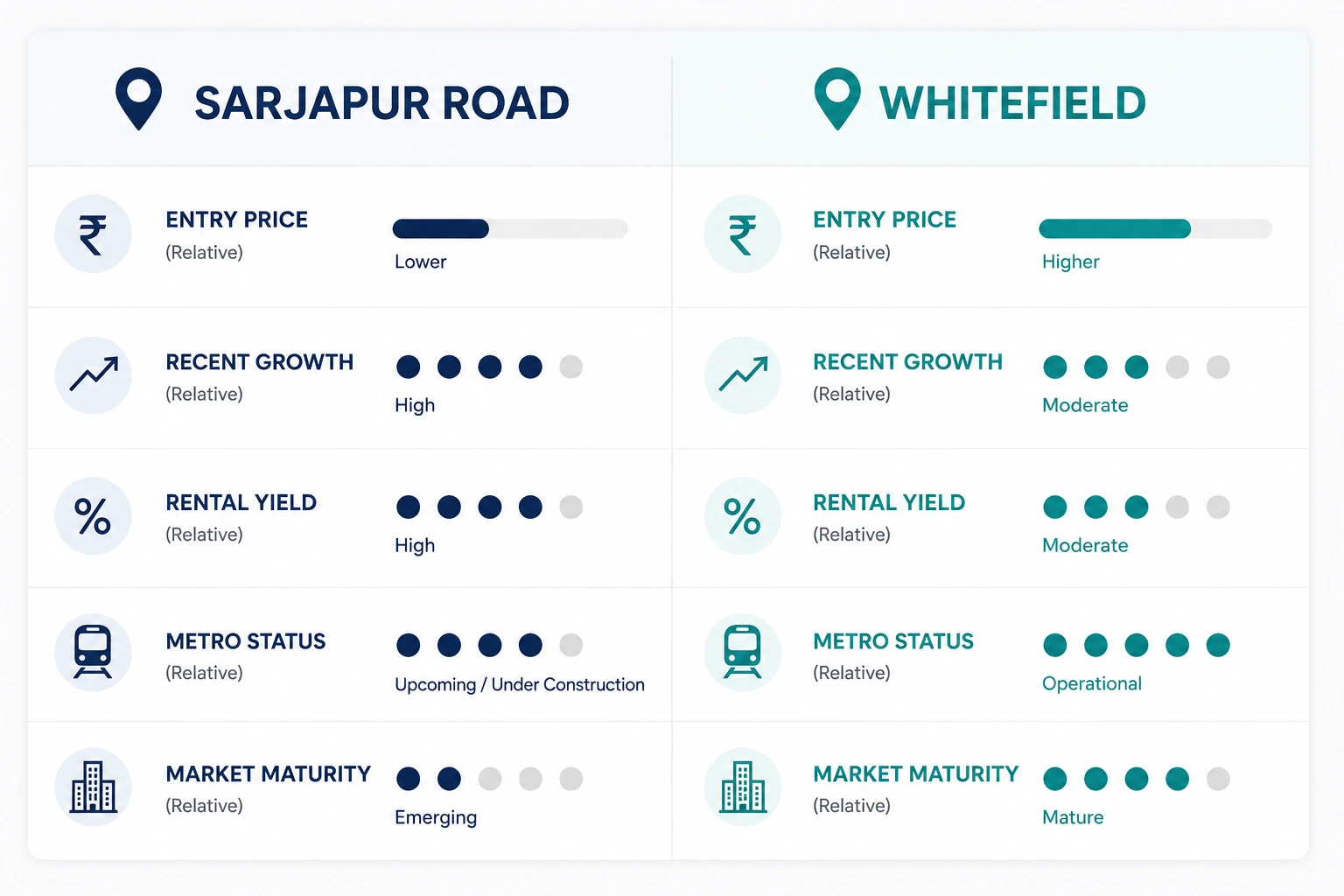
Whitefield, as one of Bangalore’s older IT corridors, has already gone through its steepest growth phase. Current pricing for a well-located 3 BHK apartment in Whitefield typically runs ₹1 crore to ₹1.6 crore depending on the micro-location and project quality, with more moderate year-on-year appreciation now that the market has matured — generally in the 6-10% range annually over the last few years.
Sarjapur Road has been on a steeper trajectory more recently. Multiple market reports tracking transaction data have shown price appreciation in the 80-110% range over the past four to five years in specific Sarjapur Road micro-markets, considerably outpacing Whitefield’s more recent growth rate. Current 3 BHK pricing on Sarjapur Road generally runs ₹1.9 crore to ₹2.5 crore in the higher-demand pockets near major employers, which is a noticeably higher entry ticket than Whitefield for a comparable configuration — but the growth curve behind that price is a different story than Whitefield’s.
The trade-off in one line: Whitefield gives you a lower entry price with slower, steadier growth; Sarjapur Road asks for a higher entry price but has shown a steeper growth curve in recent years.
This is where the two corridors diverge most sharply.
Whitefield already has an operational Namma Metro Purple Line extension, established arterial roads, and years of accumulated social infrastructure — malls, hospitals, schools, and restaurants that have had time to mature around the residential base. If you buy in Whitefield today, you’re largely buying into infrastructure that already exists.
Sarjapur Road’s infrastructure story is still being written. The Outer Ring Road connection helps, but the corridor still deals with genuine traffic bottlenecks during peak hours, and its biggest infrastructure catalyst — the proposed Namma Metro Phase 3 line connecting Sarjapur to Hebbal — is still pending final approvals and construction timelines that typically run several years even after confirmation. Buying here means partly buying a bet on infrastructure that’s coming, not infrastructure that’s arrived.
Neither position is wrong — it’s a question of whether you want to pay for certainty (Whitefield) or pay less relative to future potential for infrastructure that’s not fully built yet
Both corridors benefit from consistent IT-driven rental demand, but the numbers differ slightly. Whitefield’s more mature rental market typically yields gross returns in the 2.8% to 3.5% range — solid but unremarkable, reflecting a market where rental growth has largely kept pace with, rather than outpaced, purchase price growth.
Sarjapur Road, particularly in pockets close to major campuses like Wipro, RGA Tech Park, and Embassy Tech Village, has shown gross rental yields in the 3.5% to 5% range — meaningfully higher, driven by a rental supply that hasn’t fully caught up to the concentrated tenant demand from IT employees who want to live close to specific campuses.
If rental income is a significant part of your investment thesis (rather than pure capital appreciation), Sarjapur Road’s tighter supply-demand balance currently works in your favor.

Choose Whitefield if:
Choose Sarjapur Road if:
If you’re leaning toward Sarjapur Road specifically because of a workplace on that corridor, the single biggest lever you have to reduce your own risk is picking a project genuinely close to your employer, rather than one loosely marketed as “Sarjapur Road” while actually sitting several kilometers off the main stretch.
As an example of what a campus-adjacent option looks like: Arvind Sarjapur Road, a pre-launch project by listed developer Arvind SmartSpaces, sits directly opposite the Wipro campus and is built exclusively in 3 and 4 BHK formats across roughly 440 homes on a 5-5.5 acre site, with over 85% open space and an 18-floor mid-rise design. For a buyer specifically weighing Sarjapur Road against Whitefield because of a Wipro-adjacent job, this kind of project addresses the corridor’s biggest weakness — commute uncertainty — more directly than a project further down the road would. Details on layouts and pricing are available on the project’s official page if you want to see how a specific campus-adjacent option is positioned relative to the broader comparison above.
One honest caveat: both corridors’ recent price growth has partly been driven by genuine demand and partly by broader Bangalore-wide investor interest that isn’t unique to either location. Past appreciation is not a guarantee of future appreciation in either market, and infrastructure timelines in Indian real estate — metro lines especially — have a well-documented history of running years behind initial announcements. Treat both corridors’ “growth potential” pitch with the same healthy skepticism, and base your decision primarily on livability and rental fundamentals rather than speculative appreciation alone.
For buyers weighing this exact decision, it’s worth noting that both corridors discussed above are represented within Myhna Properties’ own portfolio, which can serve as a useful reference point when comparing what each market currently offers:
Comparing these side by side gives a practical, on-the-ground sense of how unit sizes, density, and amenity focus differ between the two corridors, beyond just the market-level trends covered above.
Whitefield generally has a lower entry price for a comparable 3 BHK apartment, typically ₹1-1.6 crore versus ₹1.9-2.5 crore on Sarjapur Road's higher-demand pockets. However, Sarjapur Road has shown steeper recent price appreciation, so the lower entry cost in Whitefield comes with a correspondingly more moderate growth trajectory.
Sarjapur Road currently shows higher gross rental yields, roughly 3.5-5%, compared to Whitefield's 2.8-3.5%, largely because rental supply near Sarjapur Road's IT campuses hasn't fully caught up with tenant demand yet.
Yes, for buyers who need reliable public transport today. Whitefield has an operational Namma Metro Purple Line extension, while Sarjapur Road's metro connectivity (Phase 3) is still pending approval and construction, meaning it could be several years before it materializes.
It's a less compelling case than if you work nearby, since a large part of Sarjapur Road's rental and resale demand is driven by proximity to specific IT campuses. If you don't have a personal commute reason to be there, evaluate it purely as an investment against other corridors on rental yield and growth potential, without factoring in personal convenience.
Given that some of the corridor's biggest value drivers (like Metro Phase 3) are still pending, a 5-7 year horizon is more realistic than a 2-3 year flip strategy, both to let infrastructure catch up and to ride out any short-term price volatility from pre-launch to possession.
A First-Time Homebuyer’s Guide to Gunjur — Documents, Loan Process, and What to Actually Check Contents The first time I
Buying Property in Gunjur From Abroad — An NRI’s Guide to Myhna Vistara Contents Every few weeks, I get some

Gunjur Property Price Trends 2026-2030 — What the Data Actually Shows Contents Every investor asking about Gunjur eventually asks some
3 BHK vs 4 BHK in Gunjur — Which Is the Smarter Buy in 2026? Contents Every family we’ve spoken
Top Schools Near Gunjur CDP Road — A Parent’s Complete Guide Contents When we started seriously considering a move
MIVAN Construction Technology — What It Actually Means for Your Apartment’s Quality and Value Contents If you have visited